This is where I turn off the honey and step onto the soapbox. I may sound and feel like vinegar, but it is a reality here in Farm Country: how to survive drought. Very few places where agriculture is the main commerce escape it.
The area we left (Virginia Beach) for Scottsville was 2-4 feet above sea level. In retrospect, it was definitely (hydrologically speaking) wetlands. The area probably should have never been developed.
Please be aware that if you purchase from some of the links on Virginia is for Gardeners, we may receive a small percentage of that sale. Your cost will be the same, regardless! Thanks for reading:)
But in the early 1900s, it was some of the only land poorer black families in the southern end of (then) Princess Anne County could afford. So they settled there and adapted farming techniques. Many of their descendants are still there today.
We bought our house there late in the 20th century. It was one of the only places that our family of five could afford in Virginia Beach that had preferred “country living elements”: wood floors, well water, and over an acre of land.
The soil was decent– like cake, actually. It was 6.5 pH by the time we left, slightly acidic. There were several 25+-year-old pines, hollies, and cedars that did a good job of providing dappled shade in our yard. These trees also made it quite unfriendly to bare feet.
Though our well was shallow, we only experienced occasional short bouts of drought. Those periods never seemed to last long. Our area of Virginia Beach (Creeds/Back Bay) was rich with riparian forests, rivers. Back Bay, Currituck Sound, and the ocean surrounded us. Water was everywhere. There were always enough drops to drink and water the garden.
This beautiful flood-enriched fertile soil and adequate rainfall definitely contributed to my surprising success as a beginning gardener.
I spent my earliest years living next to a thriving creek-side vegetable garden with quite similar soil. That easy success seduced me into believing that MORE land would be better. (Not more rain, or more water, but more SOIL). My rationale was that this would enable us to be MORE self-sufficient. HahaHA!
Moving inland
We moved three hours west to much smaller town in Virginia.
It was a tiny village compared to the metropolis of Virginia Beach/Norfolk/Hampton Roads, but ultimately closer to many things than our previous location.
In Back Bay, we lived 45 minutes from the nearest shopping areas and grocery store (including strapping kids in car seats). Our move to the outskirts of Scottsville (pop. 550, give or take a few) was just three miles to “town” That little town felt like a metropolis at the time, because of how close we were.
Restaurants; a grocery, hardware, health food and auto stores, a gift shop and a bookseller all on the same street. Less wasted gas and time driving. We wouldn’t be so housebound since the town’s center was only three miles away. Three miles was even easy hike/bike ride if we were sans car. This would be a good move!
Admittedly, we rarely walked to town. Most aspects of our migration west were good. But one thing I did not count on was the entire lack of rainfall in this area. It was a rude shock, after being surrounded by an abundance of both fresh and salt water.
We employed rain barrel at our previous address, not because we lacked water, but because of principle.
I do not care for the idea of waste. Almost everything is a resource, well-used or not. Water is especially precious. Most people agree it’s abused in this age of technological wonders and rapidity.
If hand-watering plants helps me to slow down and find some peace within myself, then I am all for it.
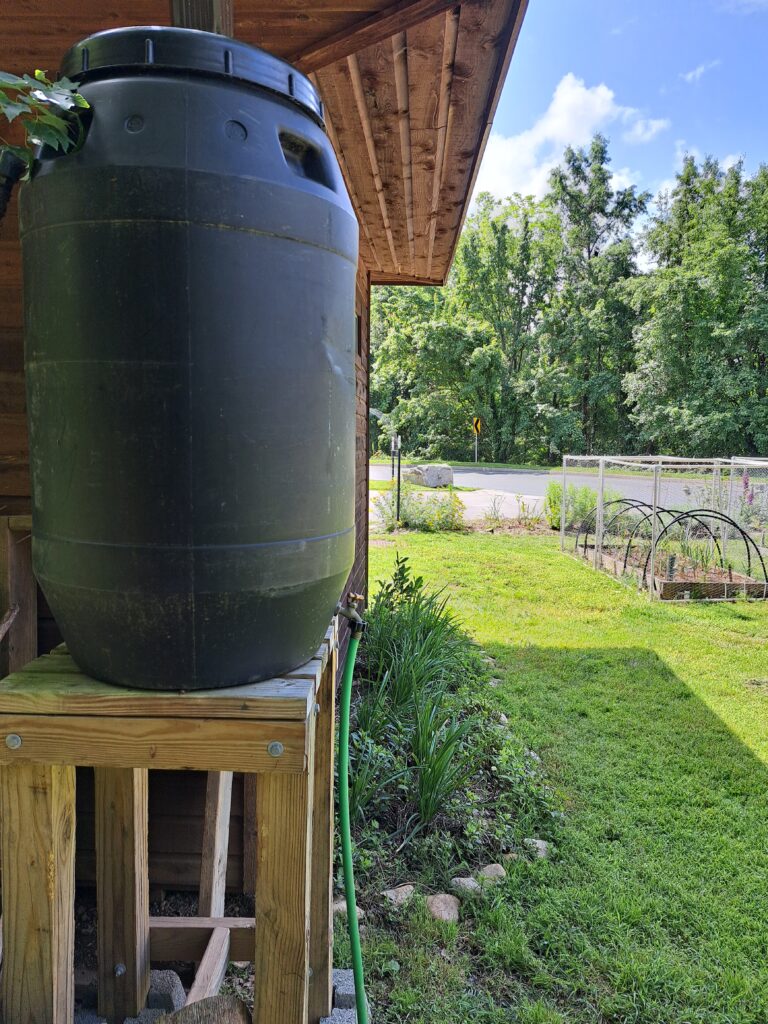
But, in 2002, and now again, (written in 2007, Ed.) the minimal amount of water our new 350-gallon rain barrel captures is welcome. It’s also a very tangible reminder that THIS IS IT. The bigger rain barrel is only worth something to us and our land when it rains.
Summertime conservation strategies helped us survive drought
In 2001, we were heavily dependent upon a mountain spring in North Garden for our drinking water.
We also “borrowed” water from friends and a laundromat where we spent many quarters down the hill. We used five to ten gallons per day for our household of five. This included our entire cooking and bathing needs, plus whatever we captured in the rain barrel.
Our camping potty was waterless, of course, and we used the aforementioned Laundromat to keep our clothes clean. Our bathing was done mostly via a solar shower which used 1-3 gallons of water.
We non-electrically heated the water by the aid of its black plastic sitting out in the sun. We really were quite excellent at the conservation game, because we had to be. Wasting very little, using all of the remaining soapy non-greasy dishwater remaining after dinner was our modus operandi.
Post-home and well construction
This is how we tended our 16’ long straw bale garden. The garden consisted of the seeds I’d saved and brought from our last house. The compost was made on-site from our food waste, coffee grounds and the bales cleared out of the loft. This barn we converted into a passive solar house.
When we finally moved into our house in June 2002, how would I know that year would be the worst drought the area had experienced so far?
We optimistically expanded our gardens, joined a CSA, and began to travel more.
Codes are not always pro-conservation
I was disappointed that no one else in the family wanted to include a composting toilet in the construction of our house. The cost was prohibitive since (by code) we’d still have to include a septic field despite not having a flush toilet. Conventional plumbing and simple economics won out: an occupancy permit and a $40 toilet versus a $1500 made more sense for us.
Our previous year’s lessons in conservation helped us limit our water use. I still could not help but feel that we’d soon forget how to conserve once we had a well and septic systems.
In some ways, I was right.
The Drought of 2002
Ironically, the alarm bells began to ring in the later part of 2002. No car washing, no lawn watering, and paper plates in effect for even the fanciest restaurants in Charlottesville. Even my children (who were all under the age of 10) laughed at the idea of paper plates being a “conservation” measure.
Alas, 2003 began and became one of the WETTEST on record.
All of the newly-conscious conservation efforts ended, and the proverbial baby was thrown out with the bath water, in our home and others. I am sure nobody was thinking too much about saving each cup of water while we were almost drowning.
Optimistic, we dug a large pond, figuring it would be a good way to keep water on our hill and handle our excess roof run-off. A pond could provide a place to grow water plants, and create a habitat for my favorites: turtles, fish, and frogs.
(We even added another, smaller landscape pond a few years later since we were pleased with the aquatic diversity that developed).
We were right about all of this, until 2007.
Another drought!
That year, we had more than thirty days without rain toward the end of the summer. By then the size of our garden tripled and we also added a 50 x 175’ plot of flowers for our first attempt at farming.
We had a garden for our own food and pleasure for YEARS. This new plot was fully mulched, so it hung on, but struggled. I’d watered the new flower field till late July, so it prospered until I gave up and wilted myself in late August.
Drought-tolerant crops
Flowers ARE a great drought crop. These flowers hung on until frost, and produced myriad colors. We made countless beautiful arrangements and a decent profit that first year, surprisingly.
However, the large pond finally gave up its last bit of water and dried down to a few oxygen-starved gallons in early October, when the bluegill almost all ended belly-up dead. (ONE survived). That was a sad day.
With mixed feelings, we celebrated the abundant rain just two days after scooping all the dead fish out of the mud. If only they could have held on for forty-eight more hours…
These drought cycles are not going away any time soon
If only we could ALL hold on.
Since moving here to increase our attempt at self-sufficiency in 2001, we learned (especially through this drought experience) that what we should be striving for is more INTERDEPENDENCY.
Seeing things like pre-programmed city sprinklers watering grass and sidewalks for lawns that benefit absolutely no one at shopping centers. Busted water mains gushing thousands of gallons of water into city thoroughfares. Poor “Streetscape” planning. These are things that no longer make me just shake my head.
These things enrage me. This is our children’s inheritance!
How many million inhabitants of the world do not have access to water? What does this type of waste say to them? Are we entitled?
I do not care for needless government intrusion into the lives and lands of people. But laws telling people that they CAN NOT have grey water systems, compost toilets, or aesthetically unpleasant rain barrels? Come on. One Virginia Beach neighborhood’s “Environmental Committee,” has a rule that hanging clothes are against their HOA laws. (WHICH environment are they concerned with, anyway?)
Laws mandating water restrictions may hurt some businesses and irritate peoples’ sense of civil liberties. But these asinine rules are more akin to cigarette smoking; if your actions hurt you (like doing illicit drugs) that is really too bad. But if they are causing people (in the case of second-hand smoke) to have asthma or (in the absence of clean water) to have diarrhea or dysentery, actions need to be regulated.
We cannot make rain fall, and de-salination is very expensive.
A Better Way
The cheapest and easiest thing to do overall is to provide extensive perks and tools for conservation.
If we have to make it chic and some kind of symbol of eco-status, i.e.: “the Joneses have a really nice water barrel,” or “Yeah, did you see the Smith’s gorgeous new compost toilet?” Then let’s make water conservation COOL! Let’s PAY people to conserve:
“I’ve seen the compost potty AND the rain barrel, but have you seen the Courts’ water bill? They actually get paid, because they are increasing water capture…they use water barrels, grow climate-protecting trees, and use less water than capture, so they are selling it to the city!”
I can dream, can’t I?