
This year (Back in 2007, Ed.) Michael and the girls asked me what I wanted for Mother’s Day. Since we’d fenced the front garden in, I could no longer see the big pond. If you read my post on Drought, you’ll know it had been pretty low anyhow. I wanted a smaller, more aesthetically pleasing pond.
Our larger pond was built with a front-end loader Additionally, we used clay, lots of Bentonite, and a drainpipe. Handily, the pipe connected to our downspouts to harvest rainwater off our roof. It had been a success in attracting frogs, birds, and bees.
Please be aware that if you purchase from some of the links on Virginia is for Gardeners, we may receive a small percentage of that sale. Your cost will be the same, regardless! Thanks for reading:)
Time to build a new, smaller garden pond
I wanted to add habitat for these creatures closer to the house. I hoped we could then watch them from indoors on the couch, or from the hammock.
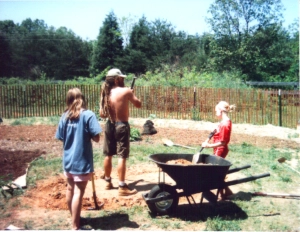
Therefore, on a beautiful, warm, and sunny May day, Michael, Jasmine, and Ajah set to work on digging a hole in our fabulous Virginia red clay.
Sometimes, if you wet red clay and smooth it over with water, it will form a substance much like “slip”. This is what potters use to attach items like pedestals and handles to their bowls and mugs. This “slip” substance can, in some lucky instances, be good at self-sealing clay and making easy ponds.
Choosing a proper natural sealant
Our first pond building experience was successful (in regard to sealing). Foolishly, we decided to remove the island in it to enlarge it. This made the pond bigger but broke the “seal.”
That is where Bentonite comes in handy.
It is a material that has many applications. Mainly its used for cosmetics and a as commercial feed binder. It is a mineral that is mined in Utah.
“Homesteaders, we have a problem…”
Okay! Dilemma: our big pond had begun to leak, so we could:
1. Drain it, entirely killing all the frogs and fish living there. We could put down black plastic and hope that frogs would return. (But also know plants, dogs, frost or any other sharp thing could negate our efforts).
2. Use concrete: ugly, heavy, and expensive.
3. Use Bentonite. We finally reasoned that Option #3, at $4 per locally available 50-pound bag was our most cost-effective solution. It would close up any leaks and blend in with the pond environment.
What is Bentonite, and how do you apply it?
To make a pond (large or small) with Bentonite, you have to dig a hole however large you want and wet the sides and bottom.
Then, using a hand-rake or other agitating tool, you apply the Bentonite in small handfuls. Start at the bottom and work your way up.
This way, the bottom will catch all errant Bentonite. With feet and hands, it gets well-worked in by the time you are done. Of course, the place you least want a leak is at the bottom of any vessel you want to hold water in.
So…after digging a 3′ deep hole, we sculpted two tiers of shelves for water plants of different heights. This allowed easier entry for frogs, turtles, bees, and other visitors.
How long will this take?
I do not know how many hours it took. I am sure it was more than we thought it would take (it always does).
But by late afternoon, the addition of Bentonite and water began to turn the hole into an exceptionally muddy spot. This is the part that seemed fun to me, as the day had been rather hot.
This is also the point at which Ajah opted out of the day-long project. She is averse to mud and had put in her fair share of work with trowels, hand shovels, and the pickaxe. No one was going to accuse her of slacking.

At this point, I am sure everyone was worried about what I’d request for Mother’s Day the following year.
And my birthday always falls the week after Mother’s Day, no matter how many years I celebrate it.
I knew I could only get but so much mileage out of these two annual gift-giving occasions in May once the pond was full. So, I relieved everyone by requesting a simple bridge and some rocks from our woods to edge the pond to complete it.
No more gifts are necessary, but I did plan on spending my gift money from my mother and grandmothers on pond fish and water plants!
May was already shaping up to be hotter than I care for, so we had a lot of evaporation the pond’s first few weeks. This required additional applications of Bentonite. Not a huge problem, since we had several bags left over from the large project a few years before.
Finally, after adding goldfish and shubunkins (another fish for ornamental ponds that grows well in Virginia), the water hyacinth started to grow and shade the water.
Michael used a few salvaged red oak boards from the barn that we had turned into our house. (An almost endless salvage project with just the wood that came out of the stall deconstruction).
The little Japanese-style bridge was simple but enabled us to sit in the middle of the pond to observe all the life in and around it.
It was also perfect for the later sailing of origami boats when we hosted Rutsu, a Japanese exchange student. More importantly, it provided shade for the fish and helped slow evaporation just a little.
Still, due to the rainless summer, the pond required topping off from the rain barrel or our well every couple of days.
By summer’s end, the little space not much bigger than a kiddie pool was ringed with sandstone and quartz, and filled with anachronous (a floating aquatic), fish, tadpoles, water mint, arrow arum, water willow, water lily, and unidentified species of plants.
We definitely spotted leopard frogs, bullfrogs, turtles, honey bees perched on delicate spongey water hyacinth, oddball mushrooms, and visiting birds (both resident and migratory) of all types.
We added a solar fountain at some point, which definitely had its shortcomings. Namely, it needs solar power from the sun, which does not happen if it’s cloudy, regardless of whether or not the pond needs filtering.
The gurgling sounds the fountain produced a welcome noise on the hottest of days, and let birds know there was water nearby.
I am sure that sound is why we had so many neotropical birds like goldfinch and indigo buntings visit us that summer. And the dragonflies were countless!
Always room to add a pond
A garden pond can be a child’s plastic pool, a whiskey barrel, a clay hole smoothed over with bentonite. A black-plastic lined sandy spot, or even a huge(ish) spot created with the best of intentions and perhaps a bit of over-zealous earth moving.
There are so many ways to create a pond for wildlife, mediation and nature-watching. Wherever I live, from now until I am gone, I hope if there is ever even the smallest place for a pond, I will have one.
Even in the case of our unfortunately un-sealed pond, no matter how the pond looks to us, the creatures that show up have loved it. They blessed us with their visitation:
A pond’s mere existence as the only invitation and welcome mat they need.
