I had no plan to be farming flowers in Virginia early in 2007. However, on a gorgeous day last Fall, my youngest daughter and I took a trip an hour south to Farmville. This was for an open house at a large, diversified farm. There were pastured chickens, a petting zoo, spinning and weaving demos, musicians, dancers, food, and reps from different farming groups. Everyone seemed happy to share their knowledge about their livestock and crops, as well as programs.

Please be aware that if you purchase from some of the links on Virginia is for Gardeners, we may receive a small percentage of that sale. Your cost will be the same, regardless! Thanks for reading:)
Fortuitous timing
We struck up a conversation with a friendly woman named Cheryl. Cheryl was from Virginia State University. I remarked on the beautiful zinnia crop at the open house. She took note of my daughter Jasmine’s name, then mentioned a program they were facilitating.
The Extension office out of VSU was trying to increase the number of cut flowers sold in Virginia to be those that were also grown in Virginia. According to some reports, less than five percent in 2007 were. I am not sure what the percentage is these days.
Why not start farming flowers?
Jasmine was immediately interested. That same summer, she’d grown her own beautiful crop of zinnias, cosmos, and coreopsis. She was hoping to increase her crop size the next year.
For me, committing to one more thing beyond bees, chickens, ducks, and fencing a newly-tripled garden space while homeschooling seemed exhausting enough. Adding another new project held less appeal.
City sanctuary flower memories
However, when I remembered our days in Richmond fifteen years before (now 20, Ed.) I realized how much I would love to grow flowers as a crop with my family.
We lived on Stuart Avenue by the Virginia Museum of Fine Arts. Across from our tidy brick row house next to the alley was St. Benedictine’s school. It took up an entire city block.
The place served as a Catholic church as well as a school for boys with a military bent. Indeed, they proudly claimed on their bumper stickers that they’d been “molding young men” even longer than the house we lived in had been around. And that house was built in 1920. (We liked to joke that they were actually advertising “moldy young men”).
One church’s trash…
I never took much notice of the boys who sometimes snuck down the alley alongside our house to smoke cigarettes. But every single Monday morning, the sanctuary’s janitor was stuffing several elaborate, still-fresh flower arrangements into the large dumpster directly across from my front porch. I’d rescue a few after he’d left, One Monday, I asked why he was throwing such beautiful flowers away.
He agreed it was a shame, but the flowers decorated the sanctuary for Sunday mornings, which then sat empty for six more days. Then, a new arrangement came, and Sunday services began all over again. It would not do to leave the flowers either rotting in there, stinking up the place.
It still seemed sad to throw out the Mums, Gerber Daisies, Roses, Carnations, and florist’s foam, vases and baskets every week. The janitor agreed with me and promised to put them on my porch instead.
I think he had been waiting for someone to ask and take the flowers home for a while, since he’d always waited until late Monday morning to dump them. Now, even when I woke up early on Mondays to start my week, I’d often find a whole porch full of flowers, waiting for me.
When things started coming up roses
And what a gift it was! These items, possibly a donation from a wealthy church member, were worth at least $100 a week (in 1990s money). More than that, if you consider the free delivery.

The best part of getting these floral hand-me-downs from the church was the fun they provided for me and my oldest daughter. Ajah was about two or three years old at the time.
Our home became an impromptu flower shop
We’d bring the flowers in, and remove them from the foam or containers they came in.
Then, we’d set out the flowers in front of us, usually disposing of the foam. After deciding which color combinations we liked, we would arrange something that looked better than the original arrangement. (Sorry, but for me, a casual country-style bouquet ALWAYS trumps a stodgy formal one).
Sometimes friends would show up who had grandmas in the hospital, or who just needed a bouquet. It gave us great joy to make custom arrangements for them. Sometimes, we’d allow them to assemble their own from all the flowers we’d salvaged.
A future of flowers
Aside from the joy of sharing things that almost were wasted, we got to enjoy fresh flowers for the rest of the week.
Unfortunately, we did not have a compost pile at the time because we were afraid of rats. We did not know about self-contained bins. Now that we do, so nothing is ever truly “spent.”
At our next home, we had a virtual playground of already-planted lilies, a whole woods’ worth of naturalized daffodils, and several flowering shrubs; there was always bouquet-worthy material. Ajah brought me bouquets (along with her sisters) almost every day for the five years we lived there.
I am not exaggerating saying that there was always some jar or vase filled with greenery in that home. it was a delight!
Begin again
After considering how nice it was to have palettes of flowers to choose from for all those years, and how much fun it would be to assemble bouquets for the market, we decided as a family to accept the grant from the Extension. We began installing and planting our first flower field in Fall of 2006.
It was a marvelous deal: we were first given peony rhizomes and Asiatic lily bulbs that Fall. After tilling and adding manure and other amendments, we planted. These went into the landscape fabric the Extension agents provided us.
It felt odd; I’d never tilled before nor used woven plastic to keep down weeds. However, the extension agent assured me I’d appreciate it the next July. He also hinted it would help flowers bloom sooner and aid the soil in retaining moisture.
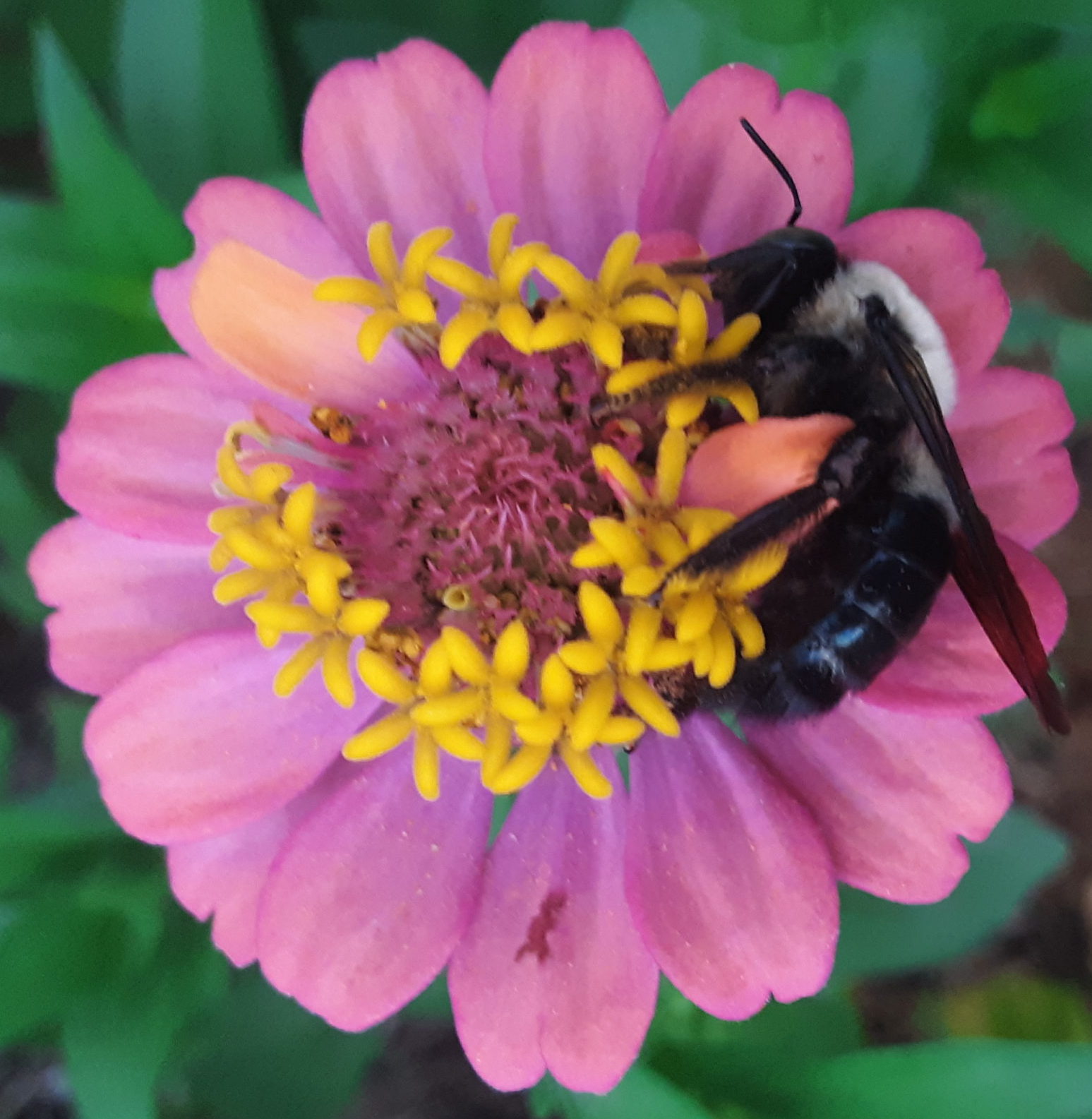
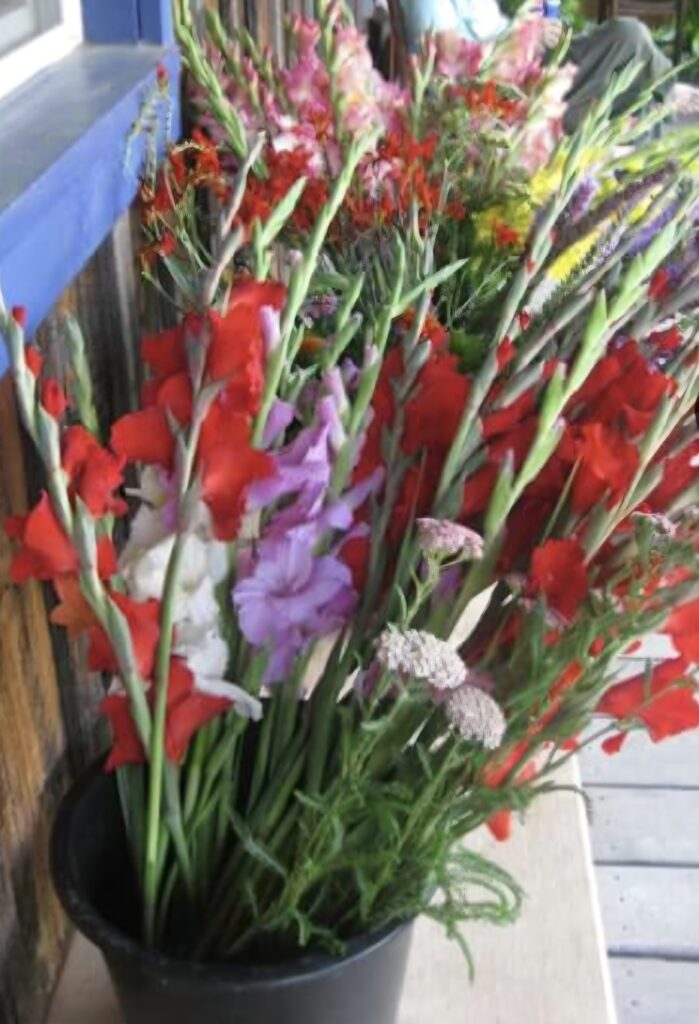
In spring through the early summer, we planted dozens of different kinds of flowers. Hydrangea, zinnia, sunflowers, lilac, evergreen holly, gladiolas, yarrow, statice, crocosmia, bleeding hearts all went into the ground that year on our little farm in Scottsville!
The first flowers sold
Somehow, we were able to plant and mulch this mind-boggling array of flowering plants by the next July. Despite my being bedridden for two weeks in late June, my family kept things hand-watered. Since we had no irrigation system, and the total plot was 150′ x 75′, this was no small feat..
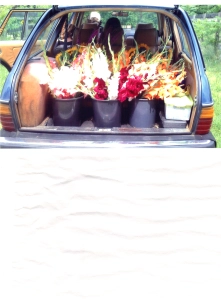
Once July hit (and I could not move), the gladiolas and sunflowers were blooming their heads off. My family devised a route of florists to visit Charlottesville. The store owners were impressed with the kids’ manners, their professionalism, and the beautiful flowers. I was so proud!
Finally, I was able to get back up and around by mid-July (just before our Japanese exchange student arrived). Jasmine and I set up for the first time at the Farmers Market in Fluvanna. We didn’t make huge profits. However, it was fun to get out and meet our farming friends and neighbors. It was also nice to have a good reason to buy local food every week.
Many markets for gorgeous locally-grown flowers
We also set up at the Scottsville Farmers Market. The weather that summer was prohibitively hot for flowers. A few times we skipped, but generally, we enjoyed our Thursdays surrounded by the fruits of our labor.
Neighbors and the tantalizing savory smells of Naveen’s wonderful Indian food made that market one of my favorites. If I made good sales, I either traded for or bought food from the surrounding stands for dinner!
A few savvy flower sales tricks….
We were quickly getting better at harvesting flowers. We also improved at prepping and arranging them. A small crowd would usually form whenever one of the kids assembled our signature bouquets: wrapped with green and white tissue paper, raffia, and a smile. People told us our bouquets made them feel like beauty queens and award winners. We loved making them feel special!
By September we were energetically spent. The hot weather had taken its toll on our crops and the market itself.
The Scottsville farmers market was called off early since that year because people just weren’t attending once the schoolyear began. A 90-degree day was almost a sure “no sale” day there.
So we drove to town with its air-conditioned florists to ply our flowers. That is what we did from the end of our first season of sales until frost arrived. It was much easier, aside from having to make the one-hour roundtrip.
A review off our first-year successes and misses
In the cool moonlight of November, temps dipped into the low 20s by dawn. Some sunflower stalks remain; summer is but a sweet memory.
We will inventory the plants that survived this past summer’s desert-like conditions, and count the empty spaces in the 50×175′ field next spring. We’ll order more from colorful catalogs that begin arriving in early January, in our mailbox.
A new year will begin. Eventually, sunny summer will arrive again for us, while we do what is surely one of the best jobs on earth: farming flowers in beautiful Virginia like its soul food!