I profess to have dreams of walking out my back door in the morning, strolling along a merry path just feet from our home, and picking strawberries, cherries, and raspberries. Or, if its later in the season, there are peaches, blackberries, and blueberries. Later, there are cantaloupe, apples, and pears. Obviously- I need an orchard. Preferably, I need to create an orchard with native-to Virginia species for wildlife (and wild people).
Anyone that grows fruit knows this is a worthy pursuit. It is also one that requires time, patience, perseverance, money, vision, more money, more time, and even more patience.
In our previous garden, I really could pick fruit for about half the year, owing mostly to prolific blackberries, and raspberries that bore in the Spring and the Fall.
Please be aware that if you purchase from some of the links on Virginia is for Gardeners, we may receive a small percentage of that sale. Your cost will be the same, regardless! Thanks for reading:)
Inland, climate adjusts
We’ve not been quite so blessed with climate and season here at Horseshoe Hill.
We are surrounded by more producers for whatever we lack, though. There are always great events and places to go. However, I possess more patience and perseverance than I did ten years ago. And vision.
We began our second year here with the knowledge heavy on our heads of the recent and seemingly un-abating drought. We sought to make the most of every drop of water that fell here. We’d use this precious resource to help establish fruit.
Choosing Virginia native species
It stood to reason that native and naturalized fruit trees would hold up better to the lack of moisture. They would also grow well, and bear sooner.
This aligned well with our bank account, too: about all we could afford were the value packs of native trees offered by our State Forestry Department.
In Virginia, you could buy ten fruit or nut trees for $8, but the catch was they were small and bare root. These trees were suited more to Virginia but not necessarily suited for commercial enterprises.
Native but exotic
One of our choices was Virginia Persimmon (Diospyrus virginiana). Its fruits appear as early orange Christmas ornaments once Fall blows their leaves away. This leaves you with a creamy apricot-like but seed-ridden fruit.
The domesticated Oriental Persimmon definitely has an edge on the native variety for sizable fruit, but the native tree’s price was nice. We also liked that our family and the trees were both Virginian.
KInd of nutty
Additionally, we chose hazelnut. Though it has an unfriendly catkin outer-covering, this ensures no one, not even the tenacious Virginia squirrels, will be stealing OUR nuts.
We also ordered Black Walnut, because we are big fans of fruit and walnut bread and know one day we might reap its eventual awards. I’ve also used hulls of walnuts for their dye.
The main reason we ordered was for the prized lumber that we will be too old to witness the harvesting of. I highly doubt I would be able to sanction its cutting if I was still alive when that happens.
There are now twelve Juglans nigra planted at our house. The tree packers stuck a few extra in the shipment, and they now line our second driveway to the little barn we are building.
With intentional Malus
We also planted crabapples and “common apples,” as they were described in the Forestry catalog. This was noted as “very unhelpfully named” by our agroforestry friend Andy.
The crabapples are a universal pollinator for all apples and are the size of cherry tomatoes at best. Perhaps one year we will make jam with them, but for now, the birds appreciate them the most.
Three-year update
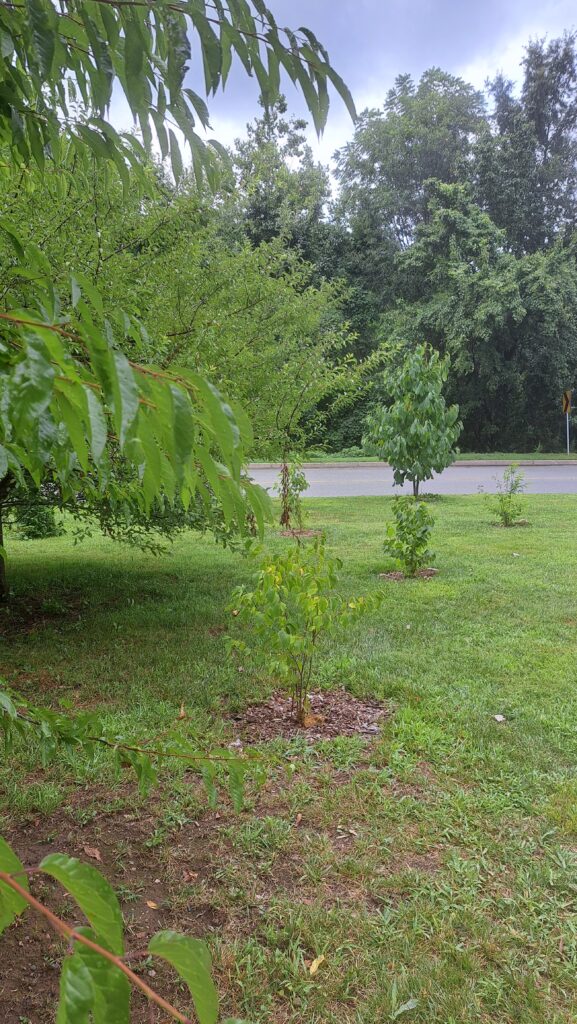
Last Fall, three and a half years after planting these beautiful trees on Earth Day 2003, we began to see the first fruits (and nuts) of our labor.
The first to bear were the hazelnuts. They tasted okay raw but were better steeped in vodka to make a sort of hazelnut extract for our coffee.
We missed many in our harvests before Fall passed us by, but before we knew it.
Spring had arrived early, too…and our apples were resplendent in their pinkish-white blooms. It was a truly glorious sight. We had no way of knowing that when we left for a permaculture workshop in Pennsylvania on April 3rd, that we’d see snow not only in Pennsylvania but in Virginia as well.
The precipitation and front brought a hard freeze, and every last bloom was dead upon our arrival home a few days later. Ahh, the travails of growing things in a Central Virginia frost pocket.
I learned (after I planted them) that apples have no business being set down on a southern slope. They tend to bloom early unless they are planted on a northern-facing slope. In that location, they were (and still are) subject to exactly what we experienced. This uncharacteristic late frost meant it would be at least a year before we sampled any apples.
I could not bear to transplant them, though, and soon enough, they were too big to do that anyway. So, they remain.
Later bloomers/producers
The persimmons and walnuts have been the last to show real ambition.
The Persimmons grew tall despite being planted in a dry spot on a dry hill. From what I read, they’d like us to all know they prefer moist spots at the wood’s edge.
Walnuts planted along the second driveway so they’d out of the way of the other plants that may not mix well with their juglone hormone. This hormone can inhibit growth of many nearby green things to reduce competition.
Instead, we located them so they might provide a shade-lined drive. Until they drop nuts onto the cars. Then, the plan is to put down a tarp and drive over them to make their hulling easier. (I have tried this since and the results are meh-Ed.)
While our tallest persimmon is now over 20′ tall, the walnuts (which were the tallest seedlings at the time of planting of all the trees) have barely grown a foot a year and are now maybe 6′ tall. (They are now, 10-12′, still growing at a rate of about a foot a year. Ed.) They are in no hurry, it seems, and my mom’s oft-repeated adage “first they sleep, then they creep, then they leap,” is not applying to them, yet.
A drought’s effects on native trees and shrubs
This summer’s drought took a toll on our first persimmon to bear. It is the smallest tree, and though it held ten fine but small orange fruits on it at the commencement of Autumn. Since then, it lost all its leaves, and it appears to be dead. Maybe it just has stage fright and does not like to be the center of attention, I don’t know. We’ll have to wait until Spring again to know if it was one of the casualties (the first of the orchard planted in 2003) of the 2007 Drought. I hope not. (It survives in 2012! Ed. )
Therein lies the beauty of the native orchard; though we’ve attempted growing several pecan, blueberry, Nanking cherry, camellia, Russian Olive, and other species, they either died or barely hang on.
Compared to the 52 fruit and nut trees indigenous our area, the results are stark. Only one persimmon appears to have died. And it did not do so until it at least produced almost a dozen tiny and tasty fruits and seeds which dry by our sink for later planting. (And, it didn’t die! Ed.)
Some fruitful conclusions
I attribute most of the trees’ successes so far to the fact that they are from “round these parts”.
They are/were native species and propagated and grown within an hour of here. These trees and shrubs know what it’s like to live in Virginia. They are well-prepared for the challenge.
It should be noted, however that we also planted them with a few smart strategies:
We planted them on bermed swales
These swales ran along the contour of our south-facing hill
These two strategies plus their location aided in watering and establishment
How did this work so well?
The shallowly dug (maybe 6″ deep) swales capture the water. The berms moderated any moisture. We then we ran chickens between the rows for a few years while the plants continued to grow. The rains would carry the chicken manure into the swales, so they benefitted from subtle and slowly-fed natural fertilization.
I worried the trees would get over-fertilized. However, the grass never seemed to burn in that area. The trees’ leaves never turned yellow until Fall. Through careful observation and application, those worries proved unnecessary. Just in case, though, we herded chickens to the adjacent coop to give the trees periodic rests.
Observation yields results and permits valuable additions
Last year (or was it the year before?) we extended the rows and added a few elderberries (Sambuca canadensis). These plants also came from the Virginia Department of Forestry. They survived and bore well within 2-3 years. T
hey are medicinal, but we don’t eat the berries straight off the bush. We use the berries for making
pancake and cough syrup, and the bees greatly enjoy their flowers.
Create a native Virginia orchard for wildlife and (wild) people
One day, I imagine we’ll either have sheep running about merrily in the shade of all these happy trees. Or maybe we’ll get really intensive, and plant under and around their growing canopies a la Forest Garden.
A forest garden with 6-7 layers: mint and comfrey as groundcover, kiwi, hops, and grapes climbing the trunks and hanging from their branches. Eggs from the hens down the hill, Apples will arrive uphill, and someone will enjoy their breakfast, one day.
Planning and planting this was so much fun. It did not cost much but time and but has been a great investment. Hopefully, I have given you a few reasons to create a native Virginia orchard for wildlife and (wild) people.