Mushrooms on pizza do not excite me. And happening upon a mushroom when I’d much rather find a fried sweet potato or cauliflower in my tempura is always unwelcome. But one Portobello burger can go a long way. Next thing you know, you are looking at seed catalogs and ordering what is known in shiitake farmer’s language as an “inoculated log.” And yes, that is how I now know a little bit about growing shiitakes mushrooms in a Virginia garden.
Of course, a log covered in shiitake spores is not cheap to ship from Maine. Swallow hard, call the 1-800 number, and order a few other things you want.…you are on the line anyways. A few days or weeks later, the heavy delivery arrives. Open up the packaging, and there it is. You are now the proud owner of an oak log with a few holes in it. Those holes were purposefully stuffed with things that look like Styrofoam peanuts. Technically, these are “spore plugs”.
Please be aware that if you purchase from some of the links on Virginia is for Gardeners, we may receive a small percentage of that sale. Your cost will be the same, regardless! Thanks for reading:)
You have been warned
At this point, your family may laugh at you for ordering such a monstrosity. You assure them you will be the one laughing, once you are swimming in shiitakes.
Shit-what? They may ask. “Shee-TOCK-ee,” you enunciate. “It’s a Japanese mushroom delicacy”.
Marching on, heading outside, you set the log slanted against a Bayberry tree out back. This log goes in shade, just as the directions directed. Then, you patiently wait, and water your log. Every day.
When will these shiitake mushrooms start growing in this Virginia garden?
At some point, you notice the plugs have been dislodged by the neighborhood feral cats. It dawns on you that, by being so conveniently located near the catnip, your shiitake log is being used as a scratching post. A very, very expensive one.
You spray them with water when they come near. The hope is that they will listen when you yell at them to go away.
I thought we were growing shiitake mushrooms?
Toward the summer’s end, it is hot and the daily watering appears to have amounted to nothing. There is a log that attracts cats that is slowly beginning to disintegrate. You conclude: “Watering a log is very non-gratifying.”
In December, six months after the special delivery, no shiitakes appeared yet.
At $40 in 1998 (which today that would be $82 plus cost of delivery), you bought yourself the most expensive Yule log in history. And Yule log it becomes. In addition to the “rare-for-Virginia” falling snow on Christmas eve, it has added a very Christmas-y vibe to the evening. Though it is still a very expensive-shiitake-Yule log- scratching post garden experiment.
Don’t give up!!! You will grow shiitakes one day in your Virginia garden
Years later, you meet a man at a farming conference from West Virginia and a place called Hardscrabble Farm.
He manages to convince you that you need this type of project in your life again.
Ridiculous as it sounds, he assures you that it may take up to a year, for your log to actually begin producing. Once it does, the logs has the potential to produce for several years, with no further effort. He tells you that he some that have produced for sixteen years now.
He laughs at your scratching post-story, nonplussed, and suggests this time you should protect the log somehow. Trust him and his instructions, he says, and all your shiitake dreams will come true.
Dreams of growing shiitakes come true
This time, much wiser than the first go-’round, you pay seventeen dollars in exchange for a light package that arrives within a week.
When it arrives, it is full of little beads of compressed sawdust, beeswax, and spores and ready to install into logs.
You can’t just use last year’s leftover firewood to install your spore plugs. They need to be pressed into 2-3′ long six-inch diameter sections of white oak ideally cut within the past two weeks.
Better yet, if you can find Sawtooth oak, use that. It’s what Japanese shiitake farmers use.
For now, you don’t have any Sawtooth on hand, but maybe you know some people who cut down 27 trees in their backyard, many of them white oaks. (We did). So, ask if it’s okay to maybe have a few of those.
They were planning to mill many of them into decking or for furniture and framing for a cabin in the woods. But, yeah, they were totally okay with sharing some of their surplus for the opportunity to also have some of the spores.
Once the log supply and proper drill bits are found, it occurs to you that a shared experience may be the making of a unique (and hopefully productive) Mother’s Day party.
So you invite some of your shiitake-curious mother-friends over one rainy day, and stoke up the cordless drills. Within a couple of hours and a couple of beers, almost twenty logs have been inoculated.It might not be what your friends envisioned when you said you were having a “Mother’s Day Mushroom Party”, but it’s still fun.
After inoculation
After inoculating, water the logs, and watch them do nothing. For a year.
The following April, at a permaculture class in Pennsylvania, wander about in the snow at the site of a future intentional non-violent community. Listen as a knowledgeable woodsman remarks upon the importance of whacking each and every log. Hard.
This draws philosophical questions about nonviolence, and the intents of the intentional community. However, a log that has been sawed and drilled into at this point will not have much to say about being whacked as well.
Aha! The missing link. You go home, whack the hell out of those innocent inoculated logs, and then “tent” them (covering them with plastic).
Oh, shiitake! SURPRISE!
To your surprise and delight, lots of little shiitake babies begin appearing all over your free-with-very-cheap-Mother’s Day spore-covered log. Dogs and roosters follow you as soon as you pick the first sizable ‘shroom. It appears that you aren’t the only one anticipating a shiitake harvest.
You make a note that the logs should be protected, and ten years after buying your first and only ever log in the mail, you harvest almost five pounds of shiitakes. More than you can eat, and more than you want.
Stretching the shiitake harvest
Drying shiitakes takes time, and patience, and only after processing them do you realize why they are so expensive; one pound of mushrooms becomes just one OUNCE when dried.
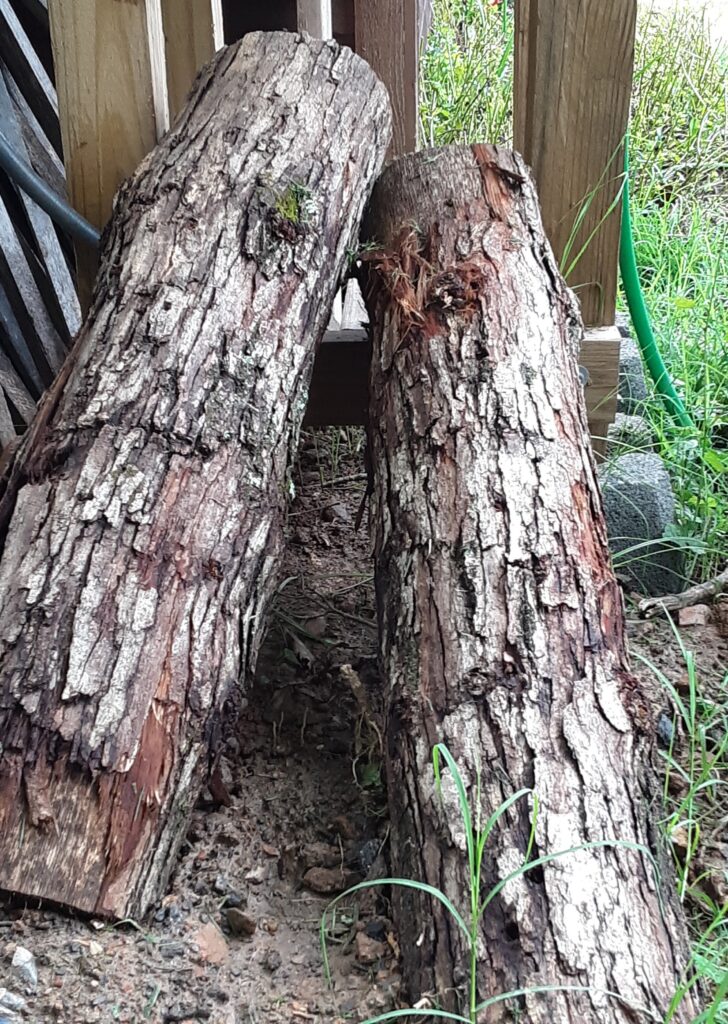
The best part of the story comes when you explain what they are to your Japanese next-door neighbor what the pile of logs are next to the fence in the former chicken tractor (to protect them).
She in turn tells you how fifty years ago, in Japan, her brother did this same thing. She paid no attention at the time. Giving her a log, you invite her to try, and you pass along some of your cache of dried mushrooms.
Shiitake dish from Sumi: A marvelous mushroom finale to the story
She brings them back to you in the most delicious Japanese stir-fried dish. She also gives you eggs, and you return some of them to her as pound cake. These are good trades. And you suspect that, in a year or so, you may be living next to a shiitake farmer if you aren’t one first.