Over the river and through the woods (and down the road apiece) lies the 150-acre intentional community Springtree. Located on the banks of the meandering and historic Rivanna River, Springtree has been demonstrating so many of the ideals I strive for (and more) for more than thirty years (Now, for more than fifty, Ed.) We had great fun learning how to make cider at their family farm.
Please be aware that if you purchase from some of the links on Virginia is for Gardeners, we may receive a small percentage of that sale. Your cost will be the same, regardless! Thanks for reading:)
Roots of the Springtree community
I found out about this nearby farm by accident when I did a search for permaculture (my passion) in and around Charlottesville. Google turned up information on a 2-week course that happened there in the early 1990s.
The course was to be taught by some of the East Coast’s most prominent players in the PC (PC as in ‘permaculture’, not ‘personal computers’) movement. I felt like I really missed out, though I did not even know what permaculture even WAS until the turn of the century.
I wondered: “Did it ever happen??
Permaculture-curious
I was obsessed with living a more permacultural lifestyle before we moved to Scottsville. We left many family and friends in familiar territory to move three hours west. Our goal was to design a better homestead from an abandoned barn and fifteen acres, and grow a lot of food and community.
We felt it would be more comfortable and productive than what we’d had in Creeds (a wetland area in southern Virginia Beach). That was the goal, anyway.
After the fact
Had we known an intentional and integral community already learned so many things we were attempting, it would have made sense to study with them. Instead, we ended duplicating some of their efforts, and (I am sure) some of the mistakes they made.
I wrote the person listed in the email on the old permaculture grouplist.
In Real Life
Thankfully the email on the seven-year-old notice was still good. I learned that the woman I emailed was none other than the sweet children’s librarian we saw every Wednesday morning. The email read simply, “Michelle, it’s me, Toots!”
When we stopped in to get our share of books later that week, she acknowledged my note in person. I had not linked her name Ruth with her nickname. I knew her by “Toots”
she filled me in on general details she remembered from the course. She also extended a welcome hand for advice and visits.
Unlike some people in the south, Toots really meant that we should visit, genuinely. It took me longer to finally make the five-mile trek to Springtree than it should have, but I finally was able to see the gardens, homes, orchards, and chicken coop of Springtree on a fine spring day. I received a wonderful tour of the place that had nurtured so much love through the years.
On a much larger scale than Horseshoe Hill (it’s a property ten times larger than our place), Springtree reflects the many people who put their time and energy into its vision and its homestead community. It is clear that the people that have continued to live there since the 1970s feel the place is there to share with those who will learn and do likewise. My family has been a grateful beneficiary of this generosity through the past several years, and we’ve gratefully harvested paw paws, persimmon, blackberries, seeds, chestnuts, and apples there. Many fruits have been born of their loving labors.
The best time was learning how to make cider at their family farm
As former homeschooling parents themselves, Springtree’s remaining four residents have opened their orchards and their cider press on a few occasions, and the taste of that particular cider has spoiled us indefinitely to any other.
Andy, the agroforester led our boisterous children and ourselves to the better-producing orchard of the day. He then instructed us to avoid poison ivy and sweat bees, while gleaning the good apples. He instructed us to throw the bad ones into the compost pile. This was to prevent apple diseases from carrying over to the following year.
It’s not unpleasant work, but it IS work. I wonder out loud if my ten apple trees will EVER bear at home. When they do, will I be able to induce my children (and others) to help out as enthusiastically as they do here? Springtree is 100+ acres of placid meadows and orchards on a former dairy farm along the Rivanna River. It is undeniably bucolic.
Manzana musings
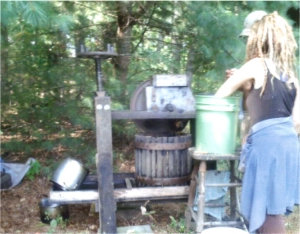
We spend a half hour or so, (depending upon the “help” the kids offer) picking apples from underneath the trees. Occasionally, we even picking some from the trees above. We then cart several five-gallon buckets through gardens over to a nice shady spot in front of their house. This is where their old cider press lives.
Operation cider
After an initial test, Andy determines we are good to go. He throws in whole apples, imperfections and all.
Occasionally a worm sighting prompts me to cut off an end or core a questionable suspect. For the most part, though, we delight in tossing them in. We watch the apple-rich juice emerge into the wooden bucket below.
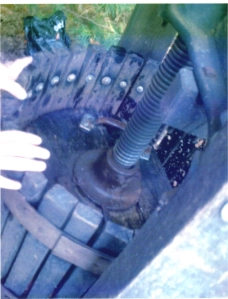
The flywheel spins and churns. Though noisy at times, it is infallible, and powers phase one of the cider-making marvelously.
After dumping all the apples in, and continually emptying discards into a compost bucket, we dodge sweat bees and dig in for the most strenuous part of the operation: pressing.
The pressure is real
This is the phase that separates the end product from being called ‘juice,’ where it turns into a cider.
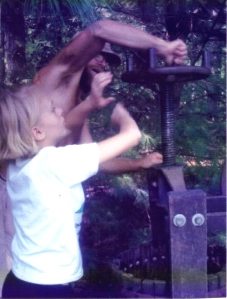
We screw the heavy wooden top down as much as possible. With our combined efforts, the remaining juice drips down, down. We use a metal bar to increase leverage for some additional ‘screw-power,’(in lack of a better term).
Ladies and gents, we are now making cider!
As the last possible drop is extracted, we set up funnels into recycled gallon jugs. Using the jugs and recycled apple juice containers, we begin the final part of the process. I feel like the world’s luckiest rustic bartender. We take each bucket to fill a container, and I try to resist sipping until I am almost done. (It proves impossible to wait, though!)
Every bit of the delicious cider is now poured out. We hose everything down, and cart off the discards (peels, seeds, etc.) to the compost.
On our short trip home, we probably guzzled half a gallon of the apple-y deliciousness.
I decide to freeze the other half-gallon. I do this so we’ll enjoy the bounty long after the last apple falls this Autumn. The amber juice is resplendent in our many bottles, and we are quite possibly buzzing like bees from this awesome and generous experience.
¡Viva Springtree, muchas gracias para las manzanas deliciosas!