
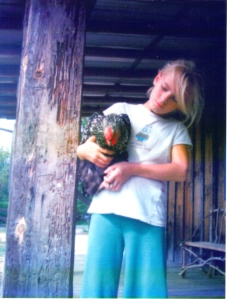
Jasmine with Cici the chicken, who provided love and eggs for years.
Ten or eleven years ago (now 25 years ago, Ed.), shortly we moved onto our own acre in the country. I began to hear the phrase “chicken tractor.” If you do not know what this is already, the image it probably conjures up a shiny, red, or green machine with big wheels. But a chicken “tractor” is a home for chickens, who provide love and eggs. For years.
Please be aware that if you purchase from some of the links on Virginia is for Gardeners, we may receive a small percentage of that sale. Your cost will be the same, regardless! Thanks for reading:)
What is a Chicken Tractor?
I kept thinking that until a friend mentioned the term in a conversation regarding permaculture. I pressed for further definition of both terms. A ‘chicken tractor’ is a movable pen for hens, roosters, and/or chicks.
This allows them to be moved to fresh grass and insects. It also protecxts them from most predators Snakes are an exception, though; they can usually penetrate most chicken tractors and coops. But snakes only eat eggs, so they aren’t predators, either.
Chicken initiation
Shortly after I began to think about adding some chickens to our organic little plot, I met a woman at a yard sale. The yard sale had been postponed, but neither of us knew that. We were already there, so we struck up a conversation.
She had an adorable daughter who apparently kept chickens. She said the chickens provided love and eggs”. Since nothing was happening at the postponed yard sale, she invited me to her place to see her chicken set-up. I followed her down to the little village island community of Gibbs Woods, North Carolina.
Once there, we saw happy birds, thriving gardens, and… chickens in our future.
We promised to stay in touch and let her know that we’d be happy to take a couple of extra birds if she had them. I thought that would be the end of our short friendship. However, the very next weekend, we’d built our first-ever little coop and chicken yard. Suddenly, we were proud parents of two hens: Heather (a Dominicker) and Harriet (a classic white Leghorn).
Pullet’s Progress
In the past ten (15, Ed.) years, we’ve rarely gone without any fowl in the yard.
The last time, it was only because we ourselves did not have a finished home. We were turning a barn into a house, which was, understandably, quite a project. Birds were bumped down a few notches on the priority list.
Since our home’s completion, we’ve decided chickens, with their love and eggs, sweet clucking and timely crowing are NECESSITIES.
We quickly made the leap from two hens to 20 plus a few roosters. The ladies went broody (meaning they just wanted to sit on the eggs that were laid, ready to incubate them). Within a few more weeks (three, to be exact) it was ‘hello, cute fuzzy chicks,’ every Easter. For years.
The original chicken yard, unfortunately, proved ineffective in keeping out predators. Its never a fun thing to find the carnage of marauding raccoons and possums in the morning. Our social lives were majorly dampened, due to having to be home every night by disk to shut the door after they all went in.
Life gets busier, Children get older
This is when we ditched coops for tractors. Our next chicken building was built from a set of plans featured in “Countryside” magazine and referred to as an “English Country Chicken tractor.” w
With two perches, a full-on nesting house, and an excellent ramp for even the less sure-footed foul, this was referred to as a “Chicken Mansion” by bemused friends ands family.
This was much nicer than our first building. But it also proved difficult to move and required two or three sets of hands to maneuver it. The birds quickly depleted parts of the lawn, so we decided to park it and try deep mulching/bedding.
Chickens in Deep mulch/Bedding
The ddep mulch and bedding meant obtaining and transporting an enormous “porch enclosure” that someone was giving away in a nearby neighborhood. We transported it slowly. It must’ve looked funny, precariously perched atop our F150 for the 45-minute drive to Pungo.
This porch enclosure was free, and basically an aviary. The person giving it away had designed it for their cat, so it could go out on the back deck without escaping.
The hens continued to live in their fancy English house, and regularly added straw, hay, compost and weeded plant matter like chickweed and henbit. Occasionally we also added oyster shells and shoveled out the area it out once the bedding/mulch was well turned and ready to compost or use on our beds.
The system worked well for about four or five years, until we moved from Virginia Beach. The last time we saw it ten years after it was put in place, there were still at least a dozen happy healthy thriving chicks.
I wish we could have moved it with us, three hours west. But that would have been like moving a small house.
New adventures in keeping chickens in the Piedmont
Here in Scottsville, we’ve built so many chicken tractors, I cannot remember them all. Still, as promised, the chickens always provided love and eggs.
We went back to a coop situation. The chickens seemed to love it, but it was not foolproof against foxes, weasels, and other small mammal predators.
We’ve made triangular pens–too light (and could be lifted by dogs).
And straw bale chicken tractors, which were nice in theory but difficult in practice (unless you are only raising chickens short-term for meat).

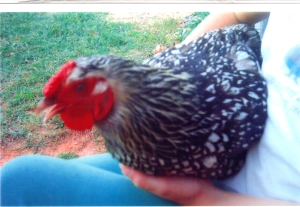
J holds Cici the Dominicker
Hens are allowed almost everywhere (check your town or county’s health codes…or not). I do not know why everyone does not keep a few birds in their backyard. We’ve also had ducks and guinea fowl, but found them to be more difficult.
We’ve yet to host turkeys or peacocks, mainly because our interest is centered on eggs.
The best farmyard memories
Children are hooked once they find their first egg, still warm, from underneath a hen. Watching a mama tend to her baby chicks is one of the sweetest versions of love you will ever witness.
Occasionally, we’ve had roosters that sounded like drunken fans at a Lynrd Skynrd show. But for the most part, any time we’ve kept the ratio of ten hens per rooster, things have gone well. We gladly received the chickens’ love and eggs and entertainment.
Top-Ranking Chicken Tractor
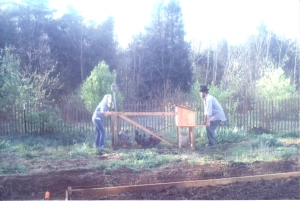
Ultimately we found long-term success with a movable pen. It was about waist high (3′ or so), four feet in width, and eight feet in length. This frame, tightly covered with chicken wire on all but the bottom, is the basic design we return to again and again.
It is safe, easily movable by anyone, and a good size to set on top of garden areas.
Additionally, if you want to clear a patch from weeds or lawn for a future garden, a chicken tractor full of hens cannot be beat.
They work systematically and joyfully on all but the hottest days for free, until the job is done. They will keep providing the service with little more than additions of pellets, kitchen scraps, garden weeds, and drinking water.
Whether you buy or build a chicken tractor, or a coop, or a straw bale structure, be sure to include a perch or two…like most birds they like to feel like they are nestled on a nice limb of a tree, even if they are only three feet off the ground. Any stick will do….you don’t want it to be too smooth or they might fall off.
People who do not have chickens will come to your house and leave amused, bemused, and mesmerized.
They will have all kinds of questions.
Even if skeptical, most people will leave, convinced that they too need a few chickens, once they meet your fine feathered flock! Cassaundra V., wherever you are: thank you for the YEARS of love and eggs from Heather and Harriet the hens you gave us. I am so glad we missed the yard sale!

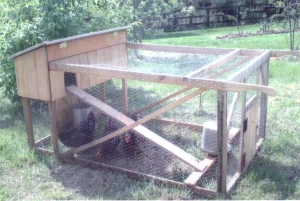
Chicken tractor, by Jasmine and Michael Courts