I would like to discuss a few permaculture strategies that you can employ no matter where you are, (as long as you have a good nearby outdoor space). I call this Zone One approach “Porch Permaculture“.
We only recommend products and services we wholeheartedly endorse. This post may contain special links through which we earn a small commission if you make a purchase (though your price is the same).
Porch permaculture in your Virginia garden
Porch permaculture, for me, includes components such as:
Seed starting
Outdoor office
Coolaroo
Drying Herbs
Drying Clothes
Vermicomposting
Rain Barrels
Window Boxes
Thank-you notes
Public radio
SEED STARTING
Let’s start with seed starting. Do you like to grow unusual plants in your Southeastern garden that are hard to find (or expensive) at local nurseries? Start them in flats or recycled pots right on your porch. Or, put them in a window box or a raised bed right off your deck to help create your own paradise.
Seedlings are gifts, cottage businesses, and a money-savers. All three, really. This is a permaculture approach: one thing has many functions. Watch them grow, then put them in a larger bed off the porch if you have a bigger yard.
OUTSIDE OFFICE TABLE
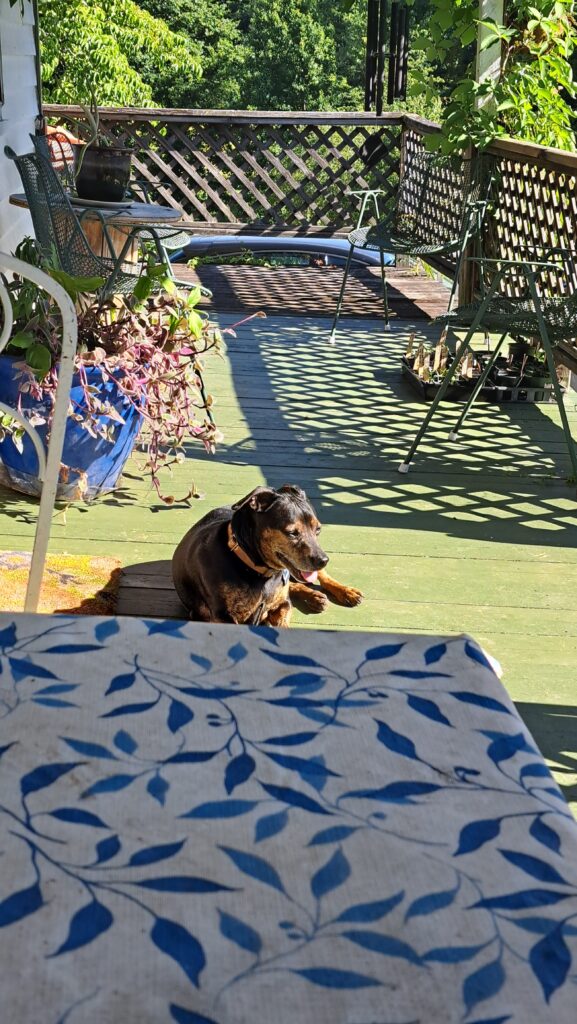
My table outside once belonged to my parents. They bought it in the early 70s when they first got married. When I work outside, I don’t have to turn on lights or adjust the temperature–cool or hot days still feel better outdoors, 9 times out of 10.
I don’t have to even listen to the radio, because the birds make music. To learn more about the birds in your yard, I highly suggest the Cornell app, Merlin. Talk about your own Permaculture Eden!
Being outside allows me to observe my garden as I plan it. I get fresh air and free Vitamin D. An “outdoor office” is definitely a good Zone One addition to your homestead, if you don’t already have one.
Coolaroo
I also like to hook up a Coolaroo if I don’t have a space on my porch that’s already shady from trees or an overhang. This handy item is like a tarp but not waterproof; it does the job quite well. If you’re establishing new tree plantings, or want to experiment with the angle a planned porch roof or overhang should be, you should definitely borrow or buy a Coolaroo.
They’re available in stylish colors, interesting, and easy-to-tie shapes. They are lightweight and portable, and I can move it as the sun, day or year goes on to create shade in minutes if needed.
DRYING HERBS
I also have a roofed area on my porch, which is good for drying herbs.To maintain their green color (and more of the vitamins and minerals within their leaves), herbs and vegetables should not be dried in direct sunlight (as counterintuitive as that may seem).
They dry better overnight at a very low temperature in an electric oven, or in a gas oven from just the heat of a pilot light. Or, on your porch, in part shade. However, if you are having extremely humid days, or its raining, this is not recommended, (unless you want a moldy mess to deal with and no fruits from your labor)!
DRYING CLOTHES
You can use your porch for drying your clothes the same way your dry bunches of herbs: on a drying rack. I prefer the wooden and bamboo collapsible types. A lot of energy is expended in homes drying clothes, and if you put them on a rack instead, you don’t have to iron things as much. Clothes don’t wear out as quickly, and you’ll use a lot less electricity by using the wind, and sun to do the job instead.
The sun will kill most germs that might have been in some of your clothes, sheets or washcloths, et cetera. I also just like it the way drying clothes in the breeze looks, and I enjoy taking the things off the line and folding them. It makes me feel happy, whereas throwing things in and out of a dryer does not.
If you want to save some money, preserve your clothes for longer, and reduce your risk of a home fire (caused by not regularly cleaning your dryer’s lint trap/screen), drying your clothes on a line or a rack on your porch is the way to go.
VERMICOMPOSTING
I have a small worm bin made out of an 18-gallon plastic tub. In it are lots of worms that eat my compost. After they eat my vegetable peelings, fruit skins and scraps, I use their poop (technically known as “vermicompost”) in my gardens.
It’s a great fertilizer for indoor plants, though it’s outside most of the time. I’ve rarely noticed any smell, but having them outside in the shade eliminates any odor issues. Also, locating them on a porch or protected outdoor area frees up just a little bit more floor space in the house once summer comes.
I have also seen handy plans for benches that are also worm bins. I love the idea, though I have never tried it myself!
Rain Barrels
A rain barrel can be kept on your porch, or it can be kept right off your porch, connected by a gutter or rain chain to your roof. It’s up to you.
If it’s up on your porch, and your gardens are down below, turn it so the spigot’s facing out. You can take advantage of the gravity to feed water to gardens below. If your porch is elevated above your yard, this will help avoid possible water damage.
Situating your barrel for optimal use
That’s probably how I’ll refashion mine soon, because my garden is currently 3′ below the decking. The 55-gallon barrel is up on a few 18×18″ paver blocks. However, it needs to be leveled again after a few years. The water has dripped down and softened the ground, causing tilting over time.
Because its only raised about 6″ off the ground, it’s also kind of difficult to get a watering can or other vessel underneath to fill it. Six inches is not much of a gravity drop to fill my gardens down below. Though I think it’ll be a good improvement, I haven’t done it yet!
From free to fashionable, options abound
The first rain barrel I had was obtained free from a health food store and used to have olive oil in it. We had to drill a hole in it to add a spigot and a washer. Getting the barrel itself free of oil was a bit time consuming. As a bonus, we did get several gallons of free extra-virgin olive oil, so it was worth our gas and time.
These days, there are many commercially-made rain barrels that are well constructed, stylish and fit all water storage needs.
Another “barrel” I have used was a much larger farm cistern/tank, and it stored several hundred gallons. Depending upon the size of your roof, it fills quickly the more roof area you have. Rain barrels reduce your household’s water bills dramatically, even if you have infrequent rain events.
Window Boxes
Window boxes are wonderful, inexpensive and add another dimension to your gardens.
I have some that currently live on the floor of my porch. I hope to get hooks to hang them from my porch railing soon. The 3′ elevation should help prevent any visiting dogs, cats and other animals from getting the flowers, lettuces and culinary herbs I’ve seeded in them with. I don’t pretend they’re safe from the birds, but it’s a good way to use space that otherwise is ignored.
Keeping things like herbs close to my house, means I can easily snip some dinner or tea. I don’t even have to walk in the yard or worry about trudging through the rain to get to them.
Additionally, some herbs (mint, citronella, thyme) help repel mosquitoes, mice and other pests from your house and smell good while you enjoy your porch time. Win. win, win!
Thank-you notes
I’m a huge proponent of writing thank-you notes. I lament that texting and email have replaced this somewhat lost art.
It is something you can do that shows people you love and appreciate them and the gifts they gave you.
Honor your creativity while tanking those you love
You can paint, sketch or reuse other things (cereal boxes cut to postcard size with a homemade collage glued on it, for instance!) for postcards. As long as one side is left clear for your legible message, address and a stamp, you have all the makings for a custom card!
The written word is still the best deal around
Sending a postcard costs less than a regular letter or greeting card. It’s a miraculous and fantastic deal to me: we can still send cards or packages anywhere in the United States for the price of a stamp without having to deliver it ourselves.
That is why I want to give a shoutout to support the United States Postal Service! And while I write my humble little thank you notes, I also like to listen to public radio.
Public Radio
If I’m outside gardening, chances are I’m also listening to public radio. There’s all kinds of different stations where I live. Here near Charlottesville, Virginia, we’re very fortunate.
Public radio for music
We’ve got musicologist-level WTJU (a station based out of University of Virginia, where I teach). Its wonderful, with all different kinds of music, including “Reggae Vibrations” which is my favorite show to garden to. WTJU also features live concerts, Irish, folk, Grateful Dead, metal, female, jazz music, and other specialty shows. It is a treasure if you are a music lover: www.wtju.net
We’ve also got one that’s more alternative college, rock-based, and it helps me keep up with some of the newer artists: http://www.wnrn.org
Public radio for News and Opinions
To add to this ridiculous wealth of listening options, we’ve got a plethora of regularly updated fact-based news stations with podcasts and really interesting stories. It’s really important right now, to support public radio because it brings the news (especially developing weather information and alerts) to rural areas, such as the area where I live.
NPR affiiliates keep people abreast of things that they might not be able to learn about because they lack a newspaper subscription or don’t have a reliable internet connection. It’s a valuable service that serves people freely. What’s NOT to love about that?
Public radio is free, but it still costs money and needs our support!
If you can pitch in a few bucks, it’s one of the best investments you can make for yourself. It also benefits your immediate community. I enjoy it especially when I’m working outside, at my little table with birds singing, or in the garden.
I feel like those two things–public radio and thank you notes– supporting things that help us all in one way or another.
Final porch musings for Virginia gardeners
Permaculture is not just about our home and homesteads, but our greater community and supporting one another.
I hope that you enjoy this season, wherever you are porching it.
 | ReplyForwardAdd reaction |